Summary of NSMoms Work Over the Past Two Years
It has been two years since a group of Nova Scotia mothers and their families began advocating for better, collaborative, and compassionate mental health care for all Nova Scotians. The following is a summary of our work over the past two years.
Why We Came Together
Every time Nancy Saunders tried to help her son access mental health care, she hit a wall. When she saw he was struggling, she called the provincial mental health intake line, desperate to get him an appointment. When she feared his medication wasn’t working, she reached out to their family doctor. But no one would speak to her.
“They told me I couldn’t speak to them because my son was an adult and had to call for help himself. It was the law,” she said.
But Ben couldn’t ask for help. His illness made it impossible to navigate the system alone. “He didn’t know who to go to or how to ask for help,” Nancy said. “No one would give me information. No one offered me help as his caregiver. Not once did anyone tell me about the Nova Scotia Circle of Care or Circle of Support—or that once a child turns 12, parents need their consent just to speak to a health-care professional. It’s the law.”
Eventually, Ben did find the strength to call the intake line himself. He was booked for an appointment four months later. Unable to advocate for himself, Ben accepted the wait.
His illness escalated to a crisis before that appointment ever came. He died by suicide in 2023. He was 29.
Ben’s story is not unique. It reflects a tragic and common reality: families and caregivers are often shut out of the system precisely when their loved ones need help the most.
This is what brought us together—and what fuels our advocacy.
Our call to action is not about violating privacy or autonomy. It’s about recognizing that mental illness such as severe depression, psychosis, and the symptom of anosognosia can impair a person’s ability to recognize they are ill. It’s about understanding that some mental illnesses cause individuals to become suspicious of or angered by those trying to help them.
Medications used to treat some mental and even physical illnesses can also increase the risk of suicidal ideation and psychotic side effects when there are underlying conditions, when mixed with other drugs, or when they are not taken according to clinicians’ instructions. When these things happen, families and caregivers should be able to ask for help on their behalf, provide vital information to health care professionals for a more thorough diagnosis and treatment plan, and have access to advice and services that support the entire family unit.
Our Work in 2024
In 2024, we shared our stories in numerous local and national media interviews, attended sessions at the Nova Scotia Legislature, and met with Opposition parties, MLAs, Ministers, hospital CEOs, academics, mental health professionals, and advocacy organizations across Canada.
We delivered presentations to:
- Halifax Board of Police Commissioners
- Family Alliance on Severe Mental Illnesses (FASMI)
- Canadian Mental Health Association (National Office and Yorkville, Ontario Branch)
- Family Support Group of NS Early Psychosis Program (NSEPP)
- Hope4Mental Health
- Nova Scotia’s “Train the Trainers – Crisis Response” for clinicians and first responders
We also consulted with mental health advocates in Manitoba, who successfully pushed for legislative changes allowing clinicians to consult with families—without the patient’s consent—when a person is at serious risk of harm due to mental illness.
On International Suicide Prevention Day, September 10, 2024, we organized a media conference at the Nova Scotia Legislature. Working with members of the Opposition and an Independent MLA, we helped introduce bills focused on legislative changes and new measures to ensure community-based, collaborative mental health care for all Nova Scotians.
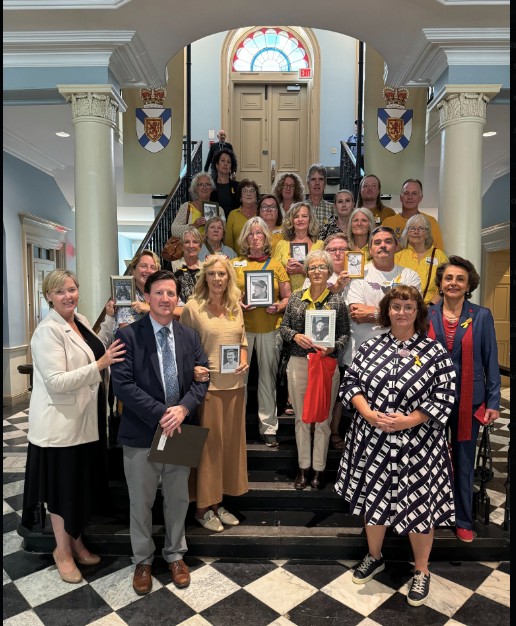
Meanwhile, families continued grassroots advocacy from Yarmouth to Truro to Halifax. We serve as peer supporters, speak at local events, share our stories to raise awareness, offer programs and services in our communities, and continue to blog and post on social media.
Our Work in 2025 and 2026
In early 2025, we began collaborating with the Office of Addictions and Mental Health, the Department of Health and Wellness, Nova Scotia Health, and the IWK Health Centre to advance four key goals we introduced last year:
- Amend privacy legislation to enable timely, appropriate communication between clinicians and trusted family members or caregivers.
- Launch a public education campaign to clarify how consent works under Nova Scotia’s “Circle of Care” and “Circle of Support.”
- Expand trauma-informed care and communication training.
- Expand public education to help families and communities recognize mental health struggles before a crisis and help families who are supporting loved ones with serious mental illness.
On March 7, 2025, a RoundTable meeting took place including 10 NSMoms, government leaders, psychiatrists, other health care professionals and government lawyers. We shared our personal stories and had discussions on ideas for improvements. From a list of action items coming out of that meeting, a few subsequent discussions were scheduled and completed with representatives from IWK, NSH, OAMH and Department of Health and Wellness and a core group of Moms. Provincial and IWK Intake, Acute Care and Crisis Intervention Training, and Consent and Information Sharing sessions were held in June, July and October, respectively. These discussions raised further areas for improvements and were a great opportunity for shared learning.
Early in the fall legislature session, the amendment to PHIA 38(1)(d) was introduced by the government and was passed on October 3, 2025, to be proclaimed on April 1, 2026. The amendment removed the word “imminent” from the PHIA clause 38(1)(d). While this amendment did not go as far as we had hoped — we had asked for the Canadian standard of “risk of serious harm” — it is an improvement and we will do all we can to ensure it goes as far as it should to enable collaboration and a much-needed change in attitude and practice.
Since the Consent and Information Sharing Session in October with the government, the focused meetings to tackle the action items from the March 7 Round Table have ceased. We have made multiple attempts to re-engage with the government to continue this work, with no answer yet on when and how this will be done. Our key priorities remain as follows:
- PHIA Implementation: Clear guidance on how the Personal Health Information Act amendments will be applied “on the ground” and the specific changes patients and caregivers should expect.
- Clinician Training: Integrating caregiver perspectives into professional development and training for all healthcare professionals.
- Family Education on Information Sharing: Developing comprehensive resources for families regarding consent, information sharing, and the provision of collateral information.
- Support for Serious Mental Illness (SMI): Establishing robust education and support frameworks for families caring for loved ones with serious mental illness.
Since the passing of the PHIA 38(1)(d) amendment in October 2025, we have placed considerable efforts into ensuring that this change is more than just the removal of a word in a clause, but a shift in attitude, culture and practice. To that end, we have been working on the following items:
- Educating all health care professionals on the laws, policies and practices relating to information sharing in the care, treatment and recovery of persons with serious mental illness and addictions. We have attended multiple conferences and seminars and did a presentation at Dal Psychiatry Grand Rounds. Presentation Link.
- Working collaboratively with the regulators, including the NS College of Physicians and Surgeons, College of Nursing, and Social Work, to ensure that Nova Scotians are protected and health care professionals have all of the tools, information and education required to provide the best care.
- Empowering caregivers and providing easy access to tools and information so that they are successful in providing and advocating for the best care for their loved ones. View caregiver tools and information.
Resources currently under development are:
- How to complain up the chain, including doctors, clinics, hospitals, and related services.
- How to complain to the regulators, including professional colleges.